
VAT Identification or Registration Number is a specific code number assigned to businesses and economic operators that carry out VAT-taxable transactions within the European Union (EU). VAT is an acronym for Value-Added Tax (VAT).
Every EU country has its own national VAT number. Indeed, the VAT is a country-specific code, incorporating a prefix that identifies the country of registration, followed by a series of digits that is unique to the business, as described below.
This number is a key element in ensuring that the tax due is correctly accounted for. It is crucial for the proper functioning of the tax system and for ensuring transparency in cross-border transactions.
That said, let’s see its structure and its use in depth.
Structure of the VAT Identification Number
As mentioned before, VAT Identification Number (VAT IN) consists of a series of alphanumeric characters, whose length and format may vary depending on the EU member state that issued it. However, there are some common elements:
-
Country code: The first two letters of the VAT Number represent the issuing country's code, according to the ISO 3166 standard.
-
Numeric or alphanumeric part: After the country code, the rest of the VAT Number consists of a sequence of digits or a combination of letters and numbers, with the structure depending on the country of origin.
Examples:
-
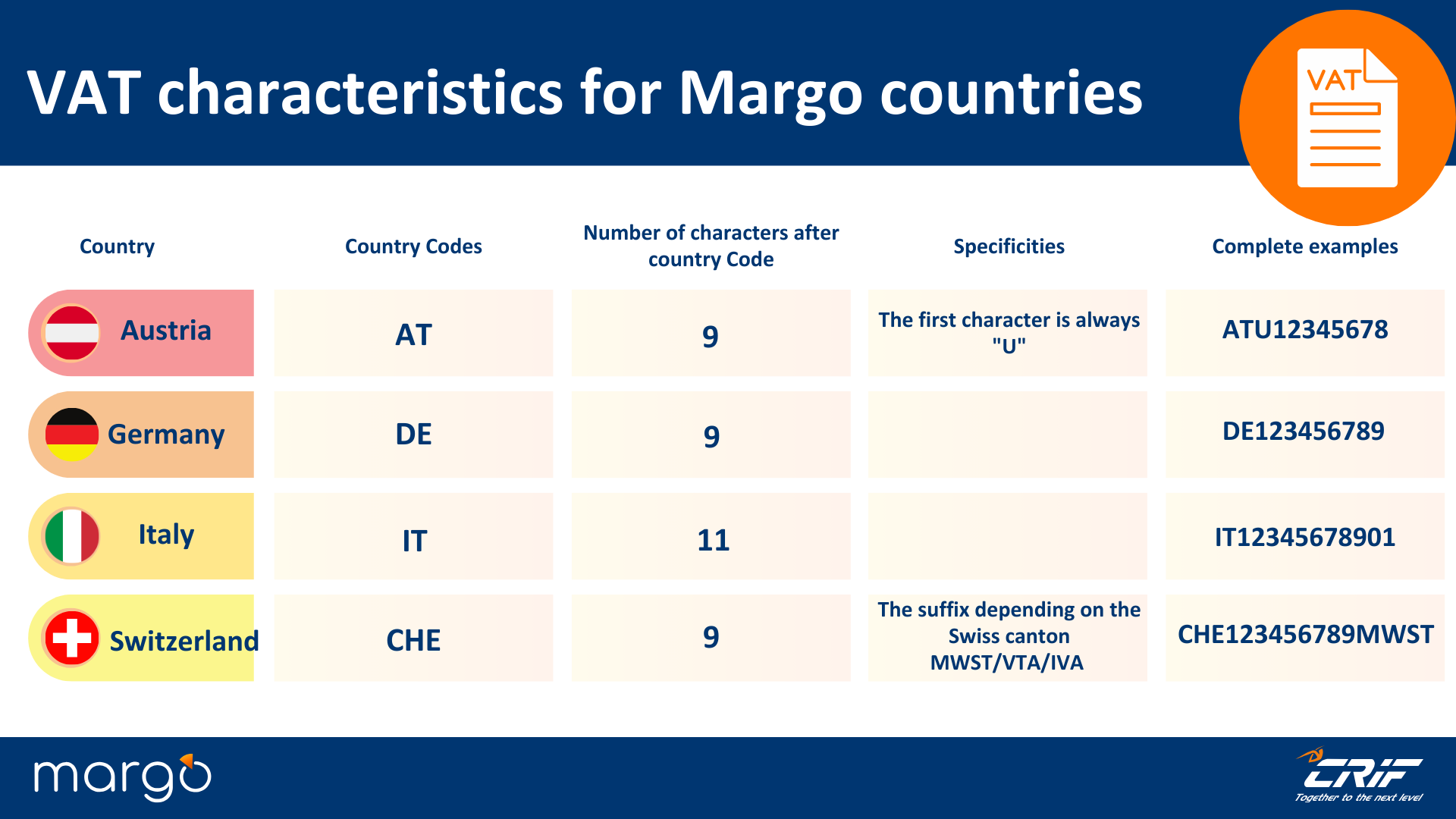
Austria: The Austrian VAT Number consists of two letters AT (the prefix of the country), the U stands for Umsatzsteuer which means „value added tax. The letters ATU are followed by eight digits, with the first digit always being a ATU12345678
-
Germany: The German VAT Number consists of two letters DE the prefix of the country and nine digits. Example: **DE123456789 **
-
Italy: the VAT Identification Number, known as "partita IVA," consists of two letters IT (the country code) followed by eleven digits. The structure is as follows: IT12345678901
-
Switzerland: Although Switzerland is not a member of the European Union, it has its own VAT system only for companies in business relationships with entrepreneurs from other EU countries. The Swiss VAT Number consists of two letters, nine digits and ends with the suffix depending on the Swiss canton: "MWST"(Mehrwertsteuer) in German, “IVA” in Italian or TVA in French.
Example: CHE-123.456.789 MWST
You can find the VAT number you need by consulting this document created by EUIPO (European Union Intellectual Property Office).
The importance of VAT Identification Number
The VAT Number is:
-
Legal Requirement for Cross-Border Trade. Without this code identification, your business would be unable to engage in intra-community supplies (sales between EU countries), which could severely limit market reach and growth potential.
-
Used to identify tax status of the business or economic customer. This is essential for tax authorities to monitor and administer VAT collection and prevent fraud. It helps to identify even the place of taxation.
-
Helps businesses comply with VAT regulations. It allows tax authorities to track the flow of goods and services across borders and ensures that VAT is correctly accounted for at each stage. It is mentioned on invoices and so, for businesses, this means that having a VAT number simplifies the process of reporting and paying VAT, as it helps differentiate between taxable and non-taxable transactions.
-
Enables VAT Exemptions on Intra-Community Supplies. If you sell goods to another business in another EU country, you may be eligible for a VAT exemption, provided that both businesses have a valid VAT identification number. This exemption allows you to zero-rate the transaction, meaning you don't have to charge VAT on the sale. The responsibility for paying VAT then shifts to the buyer in their country under the reverse charge mechanism. This not only simplifies accounting for your business, but also reduces the cost of trading across borders, making your products or services more competitive.
How to obtain a VAT Identification Number
Obtaining a VAT Identification Number generally involves registering your business for VAT in the country where your business is established. The process can vary from country to country, but typically involves providing information about your business, such as its legal structure and the types of goods or services you provide.
For businesses operating across multiple EU countries, it may be necessary to register for VAT in each country where you have a taxable presence.
How to verify the validity of VAT Identification Number
The validity of a VAT Number can be verified through the VIES (VAT Information Exchange System), an online service managed by the European Commission. This tool is used to confirm whether a VAT number is registered in an EU member state and therefore valid for intra-community transactions.
Find out more about VAT number in the European Commission website.
Use VAT Identification Number as a data to find new prospects
A VAT Identification Number is also an important financial and commercial data associated to the business. It ensures the tracking and legitimacy of activities carried out by the company and helps stakeholders to identify precisely the organization they are dealing with.
Margo, the CRIF’s marketing intelligence platform, uses VAT numbers as a driver to correctly identify the company of interest and access information about companies and potential business partners.
Indeed, in Margo you can also analyze a specific market in depth by using a list of VAT or finding new prospects with similar characteristics of current customers, which can be identified by uploading their VATs in the platform.
Margo uses other business data (such as number of employees, geographical location, industry) to offer you a tailored data quality service for your company, such as managing your customer master data, analyzing your market to grow your business and creating sales campaigns.
Contact us for more information or try the Margo platform to see the benefits for yourself-