
In the current economic context, Information Technology (IT) is not just a set of operational tools, but a strategic driver of value for businesses.
In the global market, IT is a level for:
-
Innovation: more companies are investing in new technologies such as AI and cloud computing to accelerate digital transformation
-
Efficiency: The adoption of ERP solutions and cloud infrastructure enables more agile and scalable management of business processes.
-
Security and resilience: The increase in demand for data protection and compliance solutions among companies confirms the focus on cybersecurity.
-
Digital sustainability: IT is increasingly at the heart of ESG strategies, as demonstrated by the Margo’s analysis, which views technology as a means of achieving more sustainable mobility and production.
These values guide not only technological choices, but also the long-term competitive positioning of companies.
Driving digital transformation: IT Investment trends
According to the latest "IT Spend Report 2025" from HG Insights, 16 million companies worldwide are projected to spend a total of $4.8 trillion on IT software, services, hardware, and communications services in the next 12 months.
In the EMA area in particular, approximately $518 billion will be spent on services, followed by software ($356 billion), hardware ($183 billion) and communications ($117 billion).
The IT market is undergoing a deep transformation, driven by technologies that are redefining business models and operational strategies. The EMEA region (Europe Middle East and Africa), and therefore also within the DACH region (Germany, Austria and Switzerland) in particular, are acceleration the adoption of advanced technologies due to their high digital maturity.
- Cloud computing and generative AI
- Cybersecurity
- Enterprise software for industrial digitalization
To increase agility and reduce infrastructure costs, companies are focusing on SaaS and PaaS platforms. Cybersecurity remains a key priority across the board, driven by the need to protect sensitive data and ensure regulatory compliance — particularly in sectors such as finance that are subject to regulation.
There is a growing interest in AI solutions for the software development process that focus on sustainability (economic, social and ecological) in Switzerland, as highlighted in the Swiss Software Industry Survey.
According to the report Der Markt für IT-Dienstleistungen in Deutschland (The Market for IT Services in Germany), companies are increasingly seeking strategic partners rather than just suppliers through IT providers. There will be growth in turnover in the coming years thanks to the data and AI, cloud transformation, and cyber security sectors.
But how widespread is the IT sector among companies in the DACH region? Find out in the follow paragraph.
How many companies in the DACH region operate in the IT sector? Find out with Margo
To keep up with the times, we know how important data and technology are for a growing business. For this reason, it is necessary to have tools that integrate these two aspects and simplify actions such as market analysis.
CRIF's Margo marketing intelligence platform enables you to carry out searches in just a few minutes. You can see which DACH companies prioritize this topic in their business strategies by using the semantic search.
This unique Margo feature enables you to identify from specific German keywords the companies operating in this sector within the relevant country in the region.
Using the following keywords “artificial intelligence”, “IT sector”, "Machine Learning", "DevOps", "Cybersecurity", "Cloud Computing", "IT Support" we can see that:
- in Germany there are approximately 115,031 companies
- in Switzerland there are approximately 55,868 companies in this sector
- in Austria there are approximately 29,984 companies
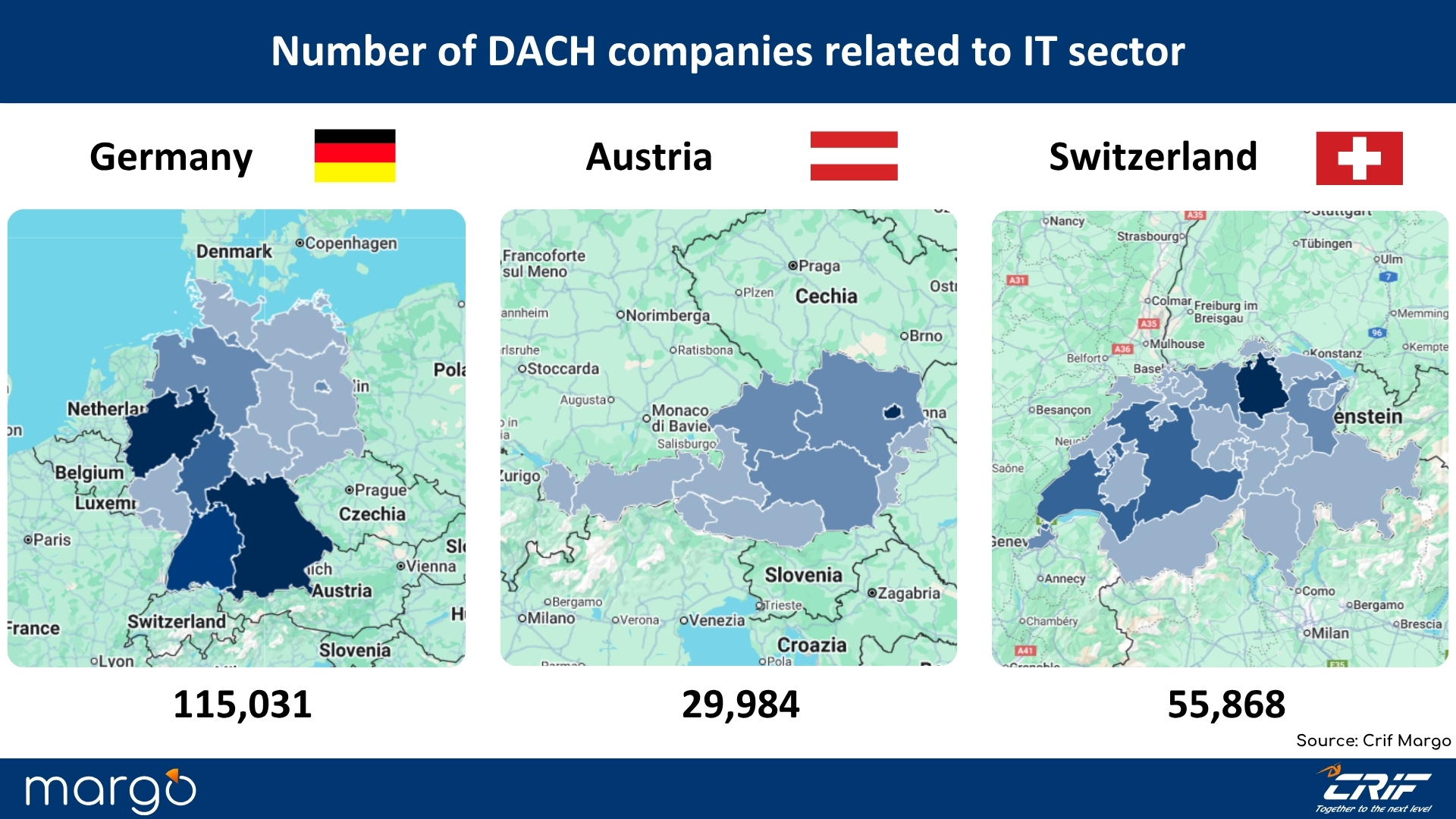
For more details in Margo, it's possible to find the different cantons/provinces through the geographical distributions and extract the companies in Excel format for further analysis.
The platform contains the full database of companies in the different districts with many enrichment data available such as: the number of employees, turnover, legal forms and NACE categories, and much more.
Margo highlights the key sectors within the NACE CODE classification system. Let's see where the highest number companies are located.
In Germany (WZ2008 classification) there are 6,967 companies operate in the “Business and other management consultancy activities”.
In Switzerland (NOGA classification) there are 3,864 companies engaged in “Business and other management consultancy activities”. In Austria (OENACE classification) 2,292 companies are listed under “Other information technology service activities”.
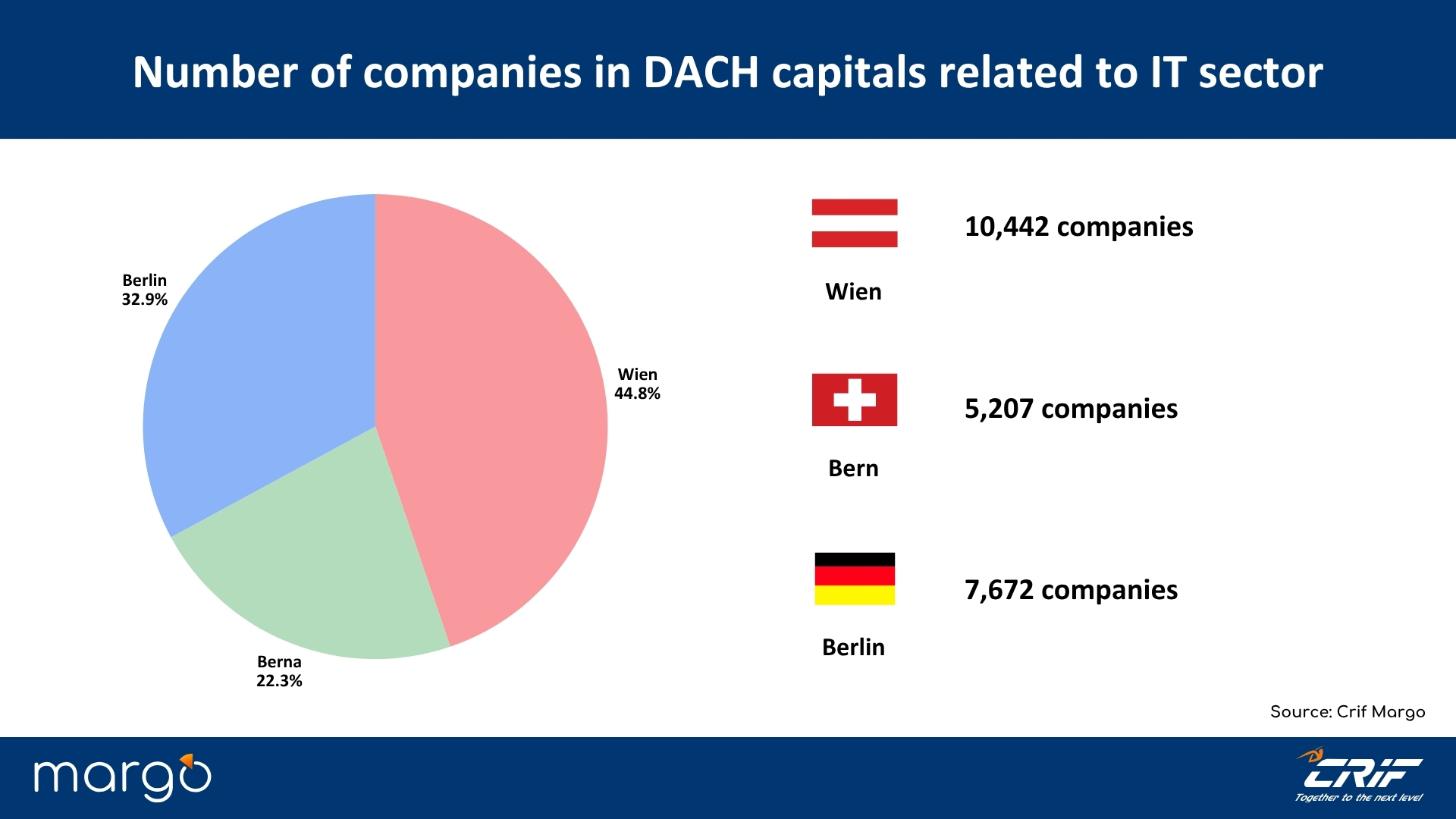
One interesting aspect of this analysis is the comparison between the capital cities of the DACH region, which are often considered as the main centers of innovation and information technology. How do they differ in terms of companies that address the topic of IT sectors?
As shown in the figure, for each capital there are companies in the IT sector:
- 10,442 in Wien
- 7,642 in Berlin
- 5,207 in Bern
From data insight to actions
The data clearly shows that the IT sector is not only thriving but also playing a crucial role in shaping the future of businesses across the DACH region. Companies are leveraging technology to drive innovation, efficiency and resilience, from cloud computing and AI to cybersecurity and digital sustainability.
With over 200,000 companies in the DACH region actively engaged in the IT sector, there are plenty of opportunities available. Platforms such as Margo empower businesses to navigate this complexity with precision by offering actionable insights to support strategic decision-making.
As digital transformation accelerates, the ability to combine data intelligence with technological innovation will become a key differentiator. Companies that embrace this shift — not just as a trend, but as a long-term strategy — will be better positioned to lead in an increasingly competitive and connected world.
If you want to stay one step ahead and are interested in learning more about the Margo platform, that allows you to find new prospects, build your customer base and create campaigns for your sales force applying specific targets please visit Margo Business Directory or contact us.