
Start-ups are transformational forces that can redefine how we live, work and connect; they are more than just businesses. Nowadays, in our evolving global economy, start-ups play a pivotal role in driving innovation, solving real-world problems and shaping the future of industries. They challenge the status quo and generate new opportunities within sectors such as technology, sustainability and health. Austria is no exception. With its thriving start-up ecosystem and growing community of founders, investors, and enablers, the country is quickly establishing itself as a hub for entrepreneurial talent and scalable innovation.
How many startups are growing in Austria?
In recent years, Austria has emerged as one of Europe’s rising innovation hubs. The country has developed a dynamic ecosystem that blends talent, capital, and infrastructure. Austria’s startup ecosystem stands out for its sectoral diversity.
According to the WKO Factsheet “Gründen und Startup – Zahlen, Daten, Fakten 2025”, Austria’s startup ecosystem is thriving, with over 3,700 startups founded since 2013 and around 30,000 people employed in the sector (excluding founders).
Deep-tech startups represent 17% of the total. They develop technological solutions based on fundamental scientific findings or technological advances and conduct their own long-term research and development for this purpose.
The most active industries for startups in 2025 include:
- 32.7% in IT and software development
- 14.6% in life sciences
- 12.2% in industrial technology, hardware, and electronics
- 7.4% in consumer goods, fashion, and food
- 5.9% in energy and mobility
- 5.9% in communication, marketing, media, and creative industries
- 4.6% in trade
- 16.7% in other sectors
Startup founders are typically 38.5 years old, with 78% holding a university degree and 74% founding as part of a team.
You can identify better all the verified startup companies in Austria through The Austrian Federal Economic Chamber But let's take a look at exactly how the startups are distributed around Austria through Margo's analysis.
Mapping Austria’s startup landscape with Margo
Through CRIF’s Margo platform, you can access detailed profiles of over 1 million Austrian companies across 9 states.
Margo has a Market Analysis module, which allows you to analyze the registered companies across Austria. Thanks to specific charts you can view all the relevant distributions by setting different criteria, such as economic activity classification (OENACE), geographical distributions, turnover, company size and employees.
By analyzing the market and by using specific filters to identify startup as:
- Incorporation date (from 2022)
- Semantic search with the main keywords in target like “Künstliche Intelligenz”, “blockchain”, “minimum viable product”, “Digitalisierung”, “Crowdfunding”, "machine learning"
We have identified 73 start-up companies in Austria with fewer than 10 employees. The geographic distribution highlights a strong concentration in key regions.
Key Insights:
- Wien stands out as the main innovation hub with 23 start-ups, accounting for approximately 31.5% of the total. This reflects the capital’s central role as a technological and entrepreneurial hotspot.
- Niederösterreich and Oberösterreich follow with 13 start-ups each (around 17.8% each), showing solid entrepreneurial activity beyond the capital.
- Tirol and Vorarlberg each host 7 start-ups (about 9.6%), indicating a notable presence despite their smaller urban density.
- Salzburg has 5 start-ups (6.8%), while Steiermark and Kärnten are less represented with 3 and 2 start-ups, respectively.
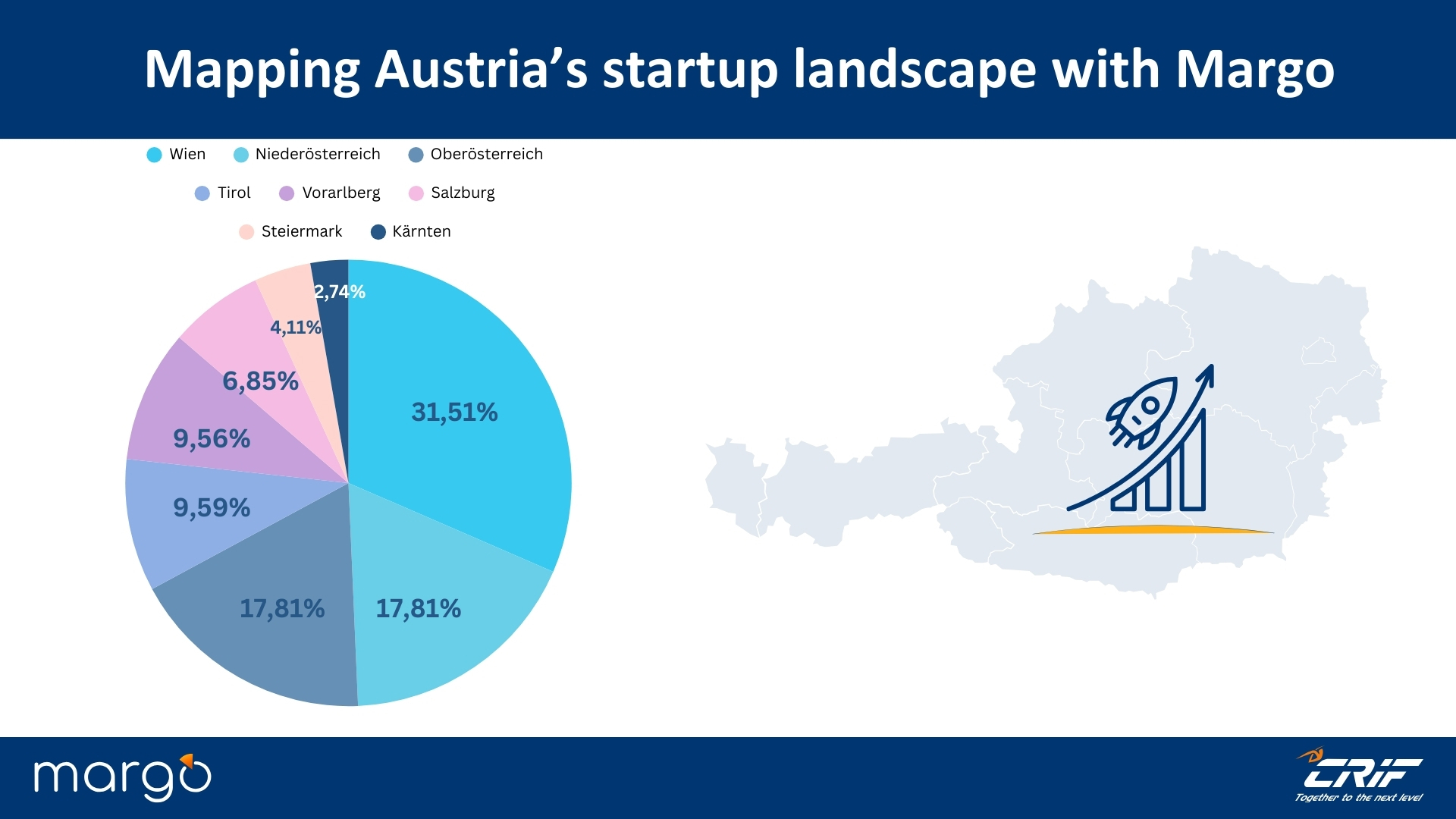
In terms of geographical distribution, start-ups in Austria appear to be more prevalent in the north of the country. This distribution may be influenced by factors such as:
- Proximity to major urban centers and infrastructure
- Access to universities, research institutions, and funding opportunities
- Better connectivity and logistics in the northern corridor
How can your startup use Margo?
If you work or you are thinking to work in startup, Margo could help you to:
- Segment and analyze companies by industry, size, turnover, and location.
- **Identify market **niches and emerging players using over 300 filters and semantic search tools.
- Monitor financial health, digital presence, and innovation potential through enriched company data.
- Discover similar companies using AI-powered similarity scoring, ideal for benchmarking and partnership scouting.
This level of detail enables investors, companies and ecosystem developers to make informed decisions, accelerate B2B growth and encourage strategic partnerships. Whether you're looking for high-potential start-ups or mapping sector trends, Margo provides a comprehensive overview of Austria's entrepreneurial landscape.
To dive deeper into how data can drive business success, join us on October 3rd for a free Austrian Startups webinar focused on optimizing customer acquisition through data-driven strategies.
And if you're keen to continuously monitor the growth of the startup industry, we recommend subscribing to a free trial of the Margo intelligence platform, your gateway to staying updated with the latest insights and developments.